I am Dara Ojo, a macro photographer and conservation storyteller based in Edmonton, Canada. Originally from Lagos, Nigeria, my early experiences surrounded by rich biodiversity shaped how I see the natural world. But it was during the quiet isolation of the pandemic in China that I truly began to look closely. That was where macro photography found me.
What began as a creative outlet quickly became a calling. I became drawn to arthropods not just for their beauty, but for their complexity. Through high resolution imagery, I reveal the textures of compound eyes, the geometry of wings, the subtle postures of hunters and pollinators. My goal is simple. To challenge fear with understanding, and replace indifference with curiosity.
My work has taken me across Nigeria, China, Costa Rica, Mexico, and Canada, documenting arthropods within rainforests, deserts, temperate woodlands, and urban edges. Each landscape tells a different ecological story, yet all are connected by the quiet labour of insects and arachnids that sustain life around us.
At the heart of my practice is a commitment to conservation. I use photography as a bridge between art and science, inviting people to slow down, look closer, and reconsider the small creatures that hold our ecosystems together.
I use macro photography to connect art, science, and conservation, revealing a world that most people pass by without noticing. Arthropods are not background details. They are engineers of soil, pollinators of crops, recyclers of life, and essential threads in every ecosystem.
My work is guided by a few clear intentions.
To inspire curiosity. I invite people to slow down and truly see these small lives, to notice the structure of a wing or the intensity of a gaze.
To shift perceptions. Fear often comes from distance. When we look closely, beauty and complexity replace misunderstanding.
To promote conservation. Through exhibitions, workshops, and collaborations with scientists and communities, I advocate for greater protection of the smallest yet most indispensable species.
To tell stories. Every image is part of a larger conversation about biodiversity, sustainability, and our shared responsibility to the natural world.
Growing up in Lagos, I was surrounded by nature in forms both subtle and wild. That early exposure shaped how I observe life today. I believe that even the smallest creature deserves recognition, respect, and protection. Through visual storytelling, I hope to inspire a deeper appreciation for the fragile systems that sustain us all.
I exhibited at the Art Gallery of Alberta as part of the Five Artists, One Love exhibition, which ran until March 30, 2025. The show explored cultural identity through photography, and I used the platform to spotlight the beauty and ecological importance of arthropods, helping shift perceptions of these often overlooked creatures.
My work is currently on exhibition at the Art Gallery of Alberta from February 16, 2026 to April 19, 2026, continuing the conversation around biodiversity, representation, and the power of visual storytelling through large scale macro imagery.
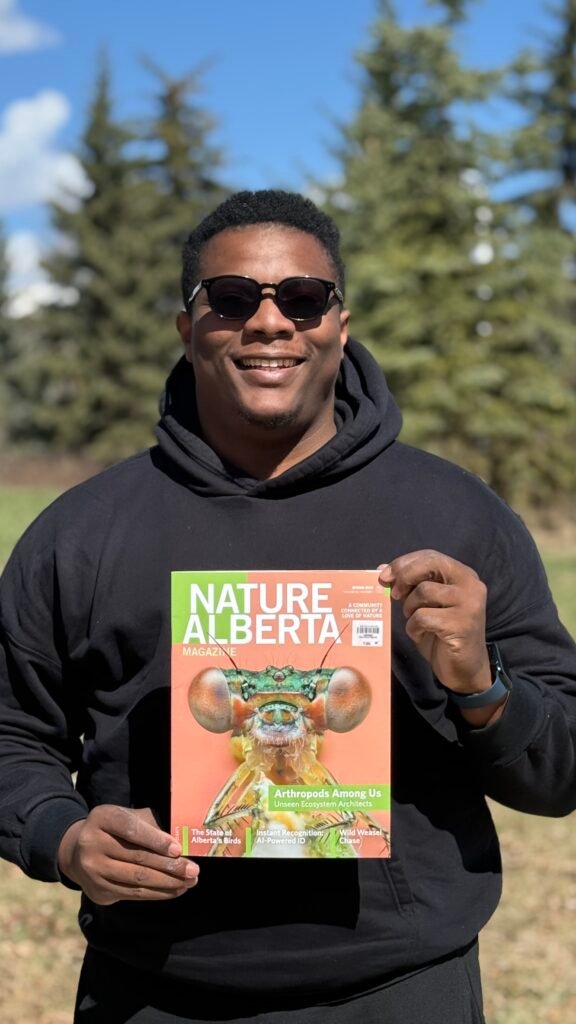
My photography has also been featured in Nature Alberta magazine, including the cover of the Spring 2025 issue, further amplifying the message of arthropod conservation across the province and beyond.
I was featured alongside leading scientists in the documentary Bugs That Rule the World, which premiered on PBS in the United States on May 7, 2025, and later aired on Love Nature in Canada on June 14, 2025, followed by a global release. The film shares my journey into macro photography and highlights the critical role arthropods play in sustaining healthy ecosystems.
Looking ahead, my coffee table book, Tiny Titans The Silent Keepers of Our Ecosystem, is set for release in Fall 2026. The book brings together my work from multiple continents, offering a deeper and more intimate exploration of the small creatures that quietly shape our world.
Beyond exhibitions and publications, I lead macro photography workshops, collaborate with conservation organizations, and engage with schools to introduce students to the hidden world of insects, bridging art, science, and conservation through visual storytelling.